
Why the Best Hotel Kitchens Train Their Supervisors to Level 3
 Online training lets a kitchen team study between shifts. Image: Event & Food Safety
Guests never see the probe check or the allergen sheet, but they notice quickly when either one fails. Tom Watts of Event & Food Safety explains why head chefs and F&B managers get the most from supervisor-level food safety training.
In a luxury hotel the food has to be right every time, and so does everything behind it. A guest booking a tasting menu or a wedding breakfast assumes the kitchen is safe. They only think about it when something goes wrong, and by then it’s a complaint or a visit from the local authority.
Our team has worked in food safety at UK shows and events since 2007. Most of the problems we see aren’t caused by people who don’t care. They come from busy kitchens where nobody senior has been trained to run the food safety system, so the checks get filled in on paper but don’t happen properly in practice.
What the law asks of a kitchen supervisor
A lot of people believe every chef needs a food hygiene certificate. They don’t. GOV.UK says plainly that “food handlers do not have to hold a food hygiene certificate”. What the law does require is that food handlers are “supervised and instructed and/or trained in food hygiene matters commensurate with their work activity” (Regulation (EC) No 852/2004, Annex II, Chapter XII). The same chapter says whoever develops and maintains your HACCP-based procedures must have “received adequate training in the application of the HACCP principles”.
In most hotels and restaurants that person is the head chef or sous chef, and sometimes the F&B manager. So the training duty falls on supervisors more than anyone else in the building. GOV.UK also says you “must be able to show that your staff have the right skills and up-to-date training for their role”, and that you should keep a record of training to show during an inspection.
Where it shows up in your food hygiene rating
When an officer inspects, they look at how food is handled and at the physical condition of the premises. The third element is how you manage food safety, “looking at processes, training, and systems to ensure good hygiene is maintained”. The FSA’s guidance for businesses says that to get the top rating of 5 “you must do well in all three elements”. Inspections come round anywhere from every six months for the highest risk businesses to every two years for lower risk ones.
That management score is where supervisor training pays off. A spotless kitchen can still lose marks if the head chef can’t explain why hot food is held at 63°C or above, or what was done the morning the walk-in fridge read high and nobody wrote it down. The officer is looking for someone who understands the system and can show it working.
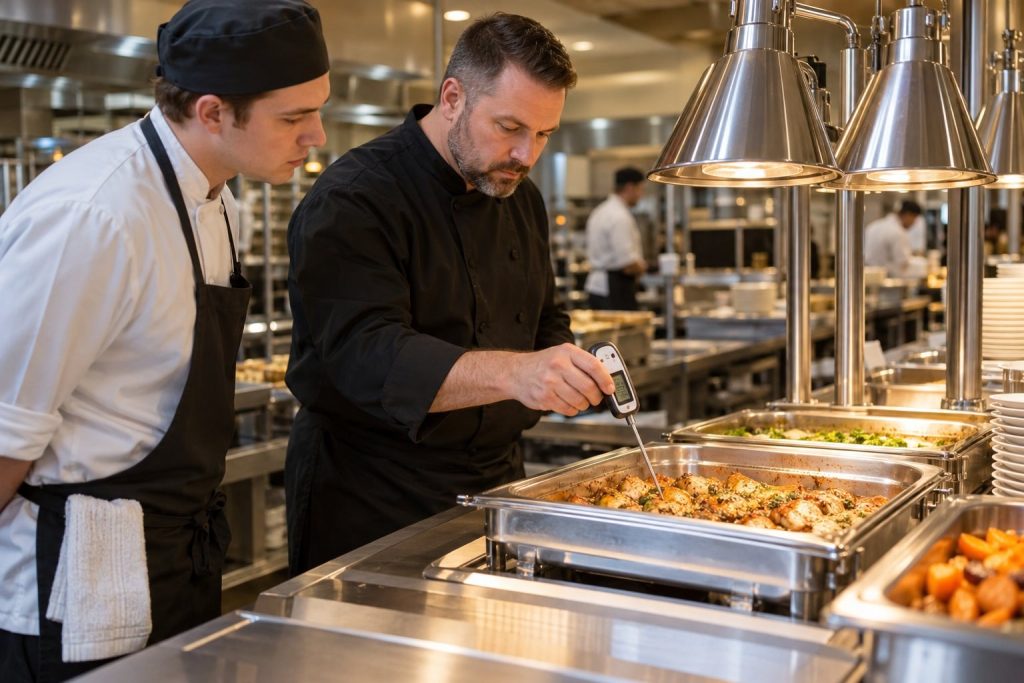
A head chef checking hot holding with a probe thermometer while a junior chef watches. Image: Event & Food Safety
Allergens, banqueting and the pressure of big service
Allergen management is where I’d push hardest. In March 2025 the FSA published best practice guidance for food that isn’t prepacked, which covers every plate leaving a restaurant kitchen. It sets the expectation for “both written allergen information and a conversation”. The legal minimum hasn’t changed, but somebody senior has to keep that written information accurate every time a recipe or supplier changes, and make sure front of house can check it rather than relying on memory.
Banqueting and outside catering are where kitchen systems get tested. A buffet needs allergen information for each dish separately, not one sign for the whole table. In England, Wales and Northern Ireland, chilled food on display can go above 8°C once, for up to four hours, and hot food can drop below 63°C once, for up to two hours. A supervisor who knows those rules can plan a canapé reception or a terrace barbecue around them and write the times down. One who doesn’t tends to either bin good food or leave it out too long.
Training supervisors without losing them from the rota
The obvious obstacle in hospitality is time. Taking a head chef out of the kitchen for two days in December is hard to justify. That’s why our Level 3 food hygiene course for supervisors is online. It takes about 6 to 7 hours over 14 video units, with no time limit, so it fits around shifts. It covers HACCP and food safety management, then the supervisor’s role in training and monitoring staff and dealing with inspections.
The course is endorsed by the Institute of Hospitality and matches the CIEH and RSPH syllabus. It was designed by a Chartered Environmental Health Officer. The assessment has an 80% pass mark with unlimited retakes, and the certificate is ready the moment someone passes, which gives you the training record an officer will ask to see.
A simple rule works for most kitchens. Anyone who supervises food handlers or runs your food safety plan should be trained to Level 3, and everyone else should be trained in line with the work they do. Guests come back for the food and the service, and good supervision is what keeps both of those safe.
Tom Watts is director of Event & Food Safety, a UK food safety business with a team of more than 20 qualified food safety advisers. It advises event organisers and venues on food safety, and provides online food hygiene training for catering teams.